The Uffizi was built by Giorgio Vasari in 1560 as offices (uffizi) for the Florentine administrative magistrates, commissioned by Cosimo I de' Medici. The top floor was converted into a gallery for the Medici art collection by Francesco I in 1581 — making it one of the oldest art museums in the Western world. When the last Medici, Anna Maria Luisa, died in 1743, she bequeathed the entire collection to Florence on the condition that it could never be moved from the city. That single act of generosity is why Florence has the collection it does.
The building is shaped like a U opening toward the Arno, with the Vasari Corridor connecting it to Palazzo Pitti across the river — a 1km private walkway built in five months for Cosimo I so he could move between palaces without entering the streets.
Top Artworks
What Not to Miss
Wikimedia Commons / CC BY-SA
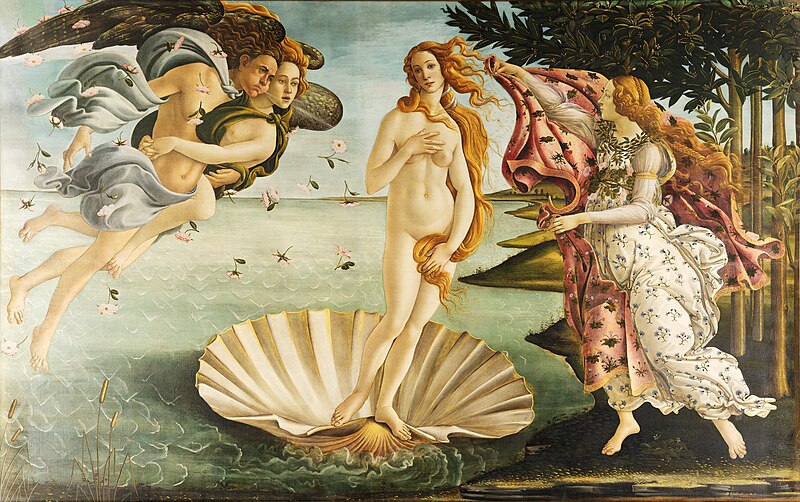
Botticelli's two masterpieces — Birth of Venus (c.1484) and Primavera (c.1480) — both painted for the Medici villa. Wikimedia Commons / Public domain
Room 10–14: Botticelli (the centrepiece)
Birth of Venus (c.1484): Venus emerging from the sea on a shell, wind gods blowing her to shore. The pose is borrowed from an ancient Greek statue. It was one of the first large-scale mythological paintings in the Renaissance — previously, secular subjects on this scale hadn't been painted at all. The figure of Venus has a subtle elongation — her neck is slightly too long, her left shoulder slightly too low — that Botticelli used deliberately to create an otherworldly grace.
Primavera / Spring (c.1480): A grove of orange trees. Nine figures in an allegory of spring. The Three Graces dancing are among the most graceful figures in Renaissance painting. This was painted for Lorenzo di Pierfrancesco de' Medici, probably as a wedding gift. Scholars have debated its exact meaning for 200 years.
★
The AnnunciationLeonardo da Vinci · c.1472 · Oil and tempera on panel · Room 15
Painted when Leonardo was about 20, possibly with help from Verrocchio's workshop. Look at the angel's wings — modelled on real bird anatomy, not the decorative feathered wings of earlier paintings. The meadow is impossibly detailed for a background. Mary's right arm is slightly too long — deliberate, correcting for the painting's original wall-mounted viewing angle.
Wikimedia Commons / Public domain
Room 15: Leonardo da Vinci
Annunciation (c.1472): Leonardo was about 20 when he painted this, possibly with help from Verrocchio's workshop. The angel's pose is borrowed from a Roman sarcophagus. The meadow background has a dreamlike quality that will become Leonardo's signature. The Virgin's arm is slightly too long — but this was intentional: she is reaching for a book on a lectern that, from the painting's original viewing angle on the wall, read correctly.
Adoration of the Magi (c.1481, unfinished): Leonardo abandoned it when summoned to Milan. The barely-sketched crowd around the Virgin and Child is one of the most dynamic compositions in Renaissance art — 50+ figures, all in motion, suggesting a crowd of humanity pressed forward by the gravity of the moment. The visible underdrawing reveals Leonardo's compositional thinking.
★
Venus of UrbinoTitian · 1538 · Oil on canvas · Room 28
One of the most influential paintings of the female nude in Western art. Venus looks directly at the viewer with complete composure — this is not a goddess but a real woman. The small dog curled at her feet is a symbol of fidelity. Manet's Olympia (1865) is a direct deliberate response to this painting.
Wikimedia Commons / Public domain
Room 28: Titian
Venus of Urbino (1538): One of the most influential paintings of the female nude in Western art. Titian shows Venus not as a goddess but as a real woman — looking directly at the viewer with complete composure. The dog curled at her feet is a symbol of fidelity. Manet's Olympia (1865) is a direct response to this painting.
Michelangelo's only finished easel painting. The muscular twisting figures of the Holy Family are unlike any other Renaissance panel painting — they anticipate the Sistine Chapel ceiling by two years. The mysterious nude figures in the background remain unexplained; scholars argue whether they are pagan, symbolic, or simply Michelangelo's exercise in anatomy.
Wikimedia Commons / Public domain
Room 35: Michelangelo
Doni Tondo (c.1507): Michelangelo's only finished panel painting. The Holy Family in a circular frame. The muscular, twisting figures are unlike any other Renaissance painting and anticipate the Sistine Chapel ceiling. The nudes in the background are unexplained; scholars argue over what they represent.
Room 2: Cimabue's Maestà (c.1285) and Duccio's Rucellai Madonna — the beginning of the story
Room 3: Giotto's Ognissanti Madonna (c.1310) — compare directly with Cimabue to see the revolution in perspective
Room 83: Caravaggio's Medusa shield and Sacrifice of Isaac (Caravaggio, Medusa, c.1597 — painted on an actual ceremonial shield. Room 83.) — late in the gallery but worth the walk
The Vasari Corridor entrance: Visible from the Uffizi — the bridge-like elevated passageway over the Lungarno
Strategy for your group: Rooms 2-3 (Cimabue/Giotto), Rooms 10-14 (Botticelli), Room 15 (Leonardo), Room 28 (Titian), Room 35 (Michelangelo). This is a focused 2-hour route. Skip the Dutch Masters in the far rooms unless someone is specifically interested.
Practical Details
Your Visit
⚠ Street eating ban near the Uffizi: Piazzale degli Uffizi is one of the four restricted zones in Florence — eating while standing on the street is banned between noon–3 PM and 6–10 PM, with fines of €150–€500. This applies immediately outside the Uffizi exit. Take any food to a nearby piazza or the Lungarno riverbank to eat.