History & Origins
Why Does This Building Exist?
The Galleria dell'Accademia was founded in 1784 by Grand Duke Pietro Leopoldo of Habsburg-Lorraine — not primarily as a public museum, but as a teaching collection for students at the adjacent Academy of Fine Arts (Accademia di Belle Arti). The idea was to surround art students with masterworks they could study and copy. Many of the finest pieces in the collection arrived here because Pietro Leopoldo suppressed numerous Florentine monasteries and convents, and their art needed somewhere to go.
The building itself is a converted 13th-century hospital — the Ospedale di San Matteo — combined with part of the convent of San Niccolò di Cafaggio. The long central hall, the Tribuna, was specifically constructed in 1882 to house the David after his move from Piazza della Signoria, creating the dramatic corridor of natural skylight the statue now stands under.
Today the museum is both a destination in its own right and an essential study collection — the room of plaster casts (gessi), hundreds of them stacked floor to ceiling, was used by 19th-century students exactly as Pietro Leopoldo intended.
The Star of the Show
Michelangelo's David — Everything You Need to Know
Who commissioned it? The Opera di Santa Maria del Fiore — the committee that managed Florence Cathedral. The original brief was to carve a series of Old Testament prophets to stand on the cathedral's roofline buttresses, seen from far below. This explains why David is so colossal: he was designed for a viewing angle that never happened.
Who is David? The biblical shepherd-warrior who killed the giant Goliath with a slingshot. But Michelangelo made a radical choice: most Renaissance depictions of David show him after the battle — victorious, Goliath's severed head at his feet (as in Donatello's famous bronze). Michelangelo shows him before — tense, watchful, his sling draped over his left shoulder, a stone in his right hand, eyes fixed on an enemy not yet defeated. This moment of concentrated, contained power is what makes the sculpture so unlike anything before it.
The "mistakes" that aren't mistakes: David's right hand is noticeably larger than his left — a deliberate choice. In Italian, destra means both "right hand" and "skill." The hand that will hurl the stone is the hand of mastery. His head and hands are also slightly oversized relative to the body — again deliberate, designed to read correctly when viewed from far below at an angle. Up close, this gives him an almost disquieting intensity.
His eyes: They look to his left — the traditional direction of an enemy or rival. Some scholars believe this is directed toward Rome, a statement about Florence's relationship with the papacy and its own political independence.
The marble itself: The Carrara block was 5.5 meters tall but extremely shallow — only about 60 centimeters deep. Every other sculptor refused it as too difficult. Michelangelo saw this as a challenge and worked within the constraint, which is why David is essentially a relief sculpture in the round rather than a fully three-dimensional figure when viewed from the sides.

What to See
Top Works in 60 Minutes
In your allocated hour, here are the must-sees in order of importance.
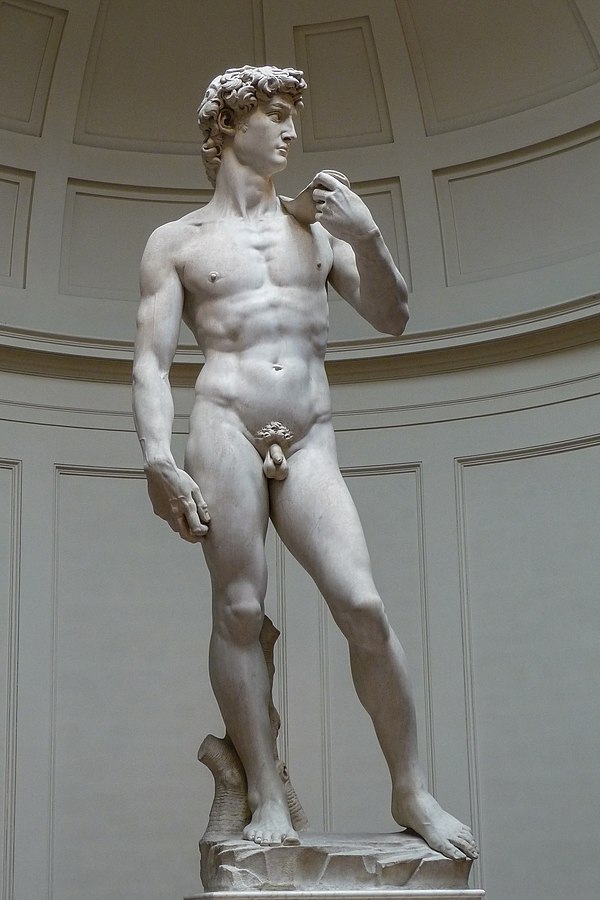
Allow 10 full minutes. Walk the full perimeter slowly. Look at him from the side — the compressed depth of the block is remarkable. Look up at his face from directly below for the expression as originally intended. Notice the unfinished quality of the hair versus the polished skin. Look at the sling over his shoulder — barely noticeable until you search for it.
- The neck veins are visible — sculpted in marble
- The pupils are carved in the shape of a heart (best seen with binoculars or zoom camera)
- The base is original; the marble plinth below it is 19th century


Awakening
Young
Bearded
Atlas
Originally intended for the tomb of Pope Julius II — a project that consumed and frustrated Michelangelo for decades. The four figures were abandoned when the tomb design changed repeatedly. They ended up in the Boboli Gardens for centuries before coming here.
- The Young Slave: Appears to be wrestling with the stone itself, face only half emerging
- The Bearded Slave: Most complete of the four — you can see the different stages of roughing-out versus finishing work
- The Awakening Slave: The most famous — a figure that seems to be pulling itself out of sleep, or out of the earth
- The Atlas Slave: Named for the figure's hunched posture carrying an invisible weight

The only work Michelangelo began from a series of twelve apostles commissioned for Florence Cathedral. He abandoned it when Pope Julius II summoned him to Rome. Matthew appears to be hauling himself upright, one arm thrown back — a pose of impossible energy. The unfinished quality here is even more dramatic than the Prisoners.
- Notice how the back of the figure is almost completely unworked — raw quarry stone
- Compare the texture of rough stone versus the polished sections of skin Michelangelo had already worked

Less famous than the Vatican Pietà but more raw and emotionally direct. The Madonna holds Christ's body with an exhausted tenderness, her face barely worked. Whether fully by Michelangelo's hand or partly by a workshop assistant, it's deeply moving.
- The unfinished Christ figure is more affecting than a polished version might be
- Look at Mary's hands — they are among the most expressive passages in the room

Easy to overlook, genuinely fascinating. Hundreds of plaster casts fill the rooms off the main hall — copies of ancient Greek and Roman sculptures used by Academy students for drawing and study. Several are casts of sculptures now lost or in fragmentary form elsewhere.
- Look for the cast of the Laocoön — the original in the Vatican is one of the most influential sculptures in Western art history
- The sheer quantity gives you a sense of how seriously drawing from antiquity was taken in 19th-century art education
- Excellent for photography — fewer crowds and dramatic white forms

An intimate, tenderly observed Madonna and Child — if it is indeed by Botticelli (some scholars attribute it to his workshop). The sea visible through the window gives the painting an unusual quietness. Worth the short walk to the upper galleries if time permits.
- The window glimpse of open sea is rare in Florentine panel paintings of this period
- Compare the softness of handling here with Botticelli's more monumental Uffizi works — the scale and domestic intimacy are deliberately different
Why This Museum Matters
What Makes the Accademia Different
Florence has four or five museums that could justify their own dedicated trip. The Accademia is smaller than the Uffizi and more focused. Where the Uffizi is a survey of centuries of painting, the Accademia is essentially about one sculptor — Michelangelo — and what it meant to make things by hand with stone and chisel.
The Uffizi shows you what Florentine civilization produced. The Accademia shows you how it was produced — the process, the struggle, the unfinished ideas, the compromise between vision and material. The Prisoners are more honest about creative difficulty than almost any finished artwork.
David himself is simply impossible until you're standing in front of him. No photograph — including very good ones — prepares you for the scale, the grain of the marble under daylight, or the uncanny sense that the figure is not quite still. The experience is different from viewing a painting: you move around it, it changes, it has weight and shadow and presence in a way that two-dimensional work cannot.
Your Visit